

Maxi-scooters have always struck me as a wild concept. Here was a vehicle conceived to make everyday commuting affordable and accessible, now endowed with the proportions and aspirations to cross countries. The idea of a scooter that could do it all was rather appealing. But spending a few hours with the Aprilia SXR GT 175 hp-e made me wonder if looking the part was half the battle.
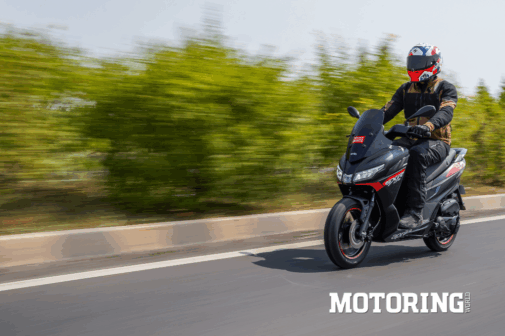
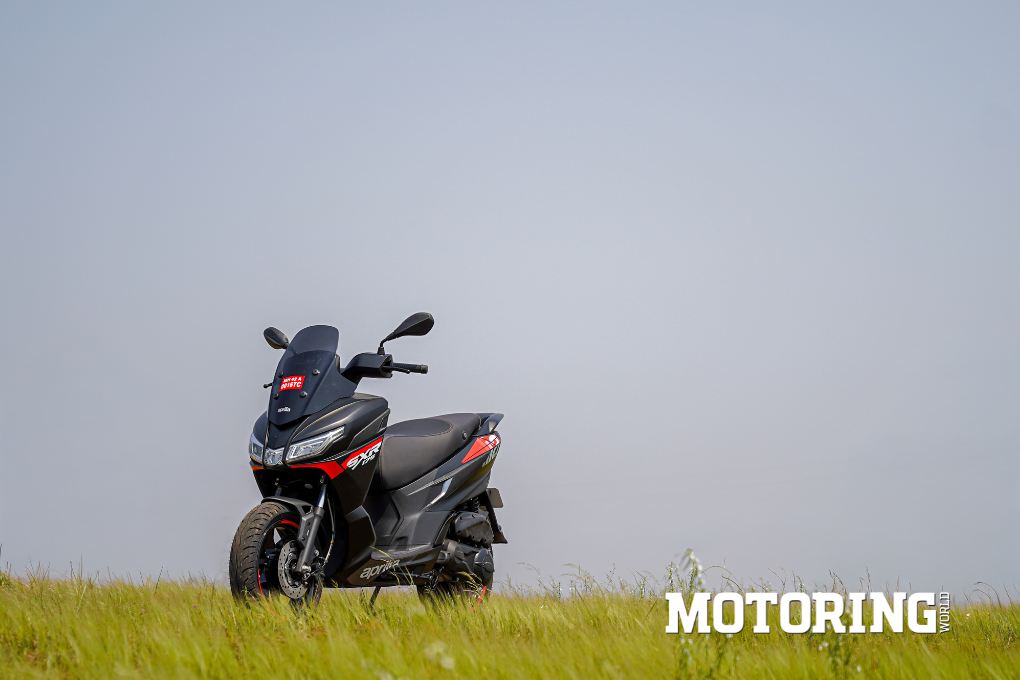
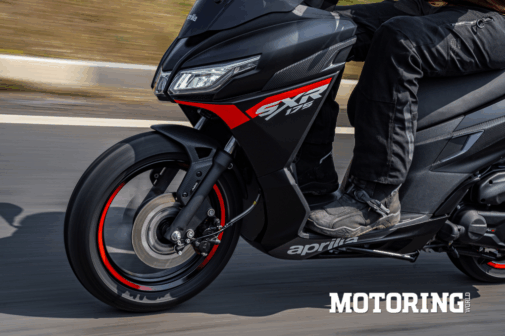
If that’s the case, the SXR wins it without trying too hard. Even those unfamiliar with the term ‘maxi-scooter’ would likely assume that the SXR GT was built for touring. And it isn’t just the overall bulk that suggests this, but the individual elements, too. There’s the tall windscreen, the 14-inch wheels at both ends, and the distinctive three-piece headlight that recalls the rather outrageous Aprilia SRV 850.
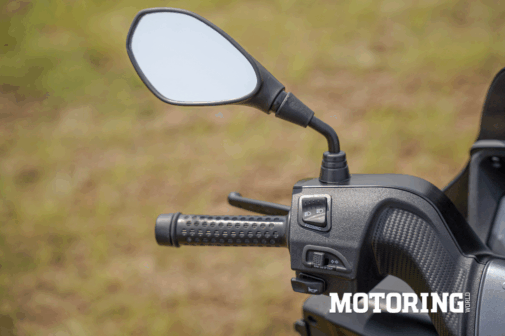
That perception shattered the moment I sat on it. Suddenly, I felt like a giant astride a puny moped, when the experience on most maxi-scooters, or even maxi-style scooters, is quite the opposite. The handlebar felt too low and narrow, while the mirror stalks were too short. Every time I checked for traffic behind me, I had to look down rather than simply glance at the mirrors. The same was true of the speedometer. I didn’t mind looking down to check my speed, but having to take my eyes off the road to check my mirrors was a different matter altogether.
Thankfully, the 174.4cc air-cooled single-cylinder was quick to distract me from those woes. With 13 bhp and 14.14 Nm at my disposal, there was some fun to be had. Here’s where things get interesting: the SXR is no slouch. With the throttle wide open, it accelerated to an indicated 100 kph without much fuss. Even when the limiter kicked in at an indicated 108 kph, the engine didn’t seem particularly stressed. I held it there for around 30 km, and it never gave me reason to worry. There were no discernible vibrations, nor did the engine sound like it was crying for mercy. The let-down came when I rolled off the throttle or slowed down. Getting back up to speed took more effort than I’d have liked, making quick bursts of acceleration less convincing than its outright performance suggested.
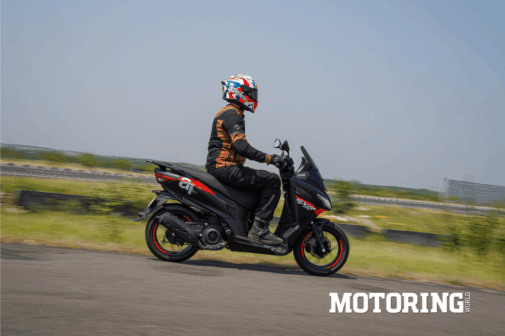
Perhaps I was expecting too much. I decided to ease off, take in the countryside and give myself a break from chasing speed. So I tried to scoot back on the long seat and stretch my feet out onto the maxi-style footboards. Except I couldn’t. The seat’s contour kept me locked into one position, while the floorboard was too narrow for my size-13 feet to rest comfortably on its inclined section. So much for settling in for the long haul.
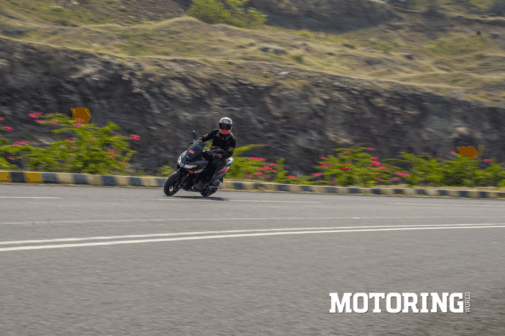
The suspension didn’t help matters, either. It was on the firmer side, which, in isolation, isn’t necessarily a bad thing. But the front-end rebounded so quickly over bumps that the impact travelled straight to my hands. Instead of feeling composed over rough patches, the SXR was rather jarring. And if a firm setup was meant to make it a willing corner-carver, the tyres had other ideas. The Ceats offered little feedback, leaving me short of the confidence needed to lean into corners with any enthusiasm. The chassis might have looked ready for a spirited ride, but the tyres weren’t particularly keen on joining the party.
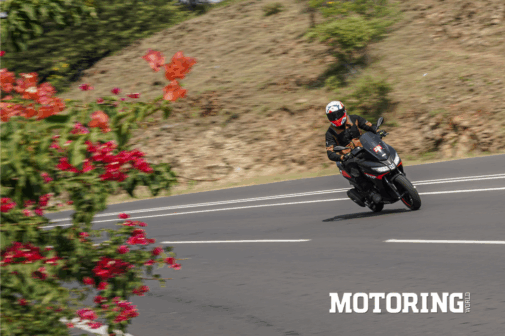
There was, however, one part of the riding experience I had very little to complain about were ‑the brakes. The front brake, in particular, was phenomenal for a scooter. There was ample stopping power, backed by reassuring feedback at the lever, and the SXR could shed speed without any drama. It was one of those rare instances when the scooter felt every bit as substantial and capable as its styling suggested.
The same couldn’t be said of its practicality. The instrument console is neatly laid out and easy to navigate, although the two buttons marked ‘mode’ left me wondering why the functions couldn’t have been consolidated. One scrolls through the menu pages, while the other cycles through basic information. It’s hardly a deal-breaker, but it feels unnecessarily complicated.
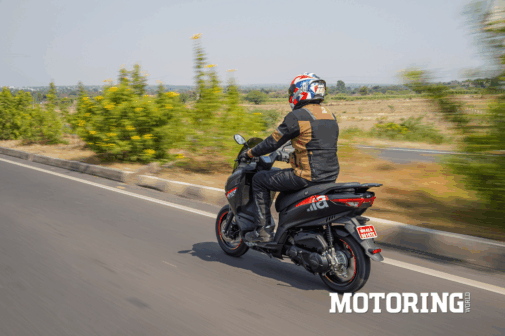
The apron-mounted storage spaces are another example of a good idea that doesn’t quite deliver. The left-side compartment houses a USB charger, while the one on the right is intended to hold a bottle. But my phone wouldn’t fit comfortably in the charging compartment, defeating the purpose of having a convenient place to charge it. Then there’s the absence of an external fuel filler cap, a feature that would have made refuelling considerably more convenient. With around 22 litres of under-seat storage, at least there’s enough room to carry everyday essentials.
That’s what makes the SXR GT such a curious proposition. At ₹1.30 lakh (ex-showroom), it has the price and the visual appeal to attract younger buyers looking for something that stands apart from the usual sea of scooters. I can understand the attraction. The styling is distinctive, the engine is willing, and the brakes are excellent. But the experience feels a little too conservative for a scooter that makes such a bold statement.

Here’s the problem. The maxi-scooter concept is appealing precisely because it promises to stretch the boundaries of what a scooter can do. It should offer the convenience of a conventional scooter without making you feel confined to the daily commute. The SXR GT, on the other hand, seems more interested in looking the part than delivering on that promise.
There’s also the Aprilia SR GT 200 Sport. Knowing that Aprilia already has a scooter with more do-it-all hardware in its stable makes the SXR GT’s compromises more noticeable. The SXR has the proportions of a long-distance companion, but the ergonomics, suspension and tyres don’t quite encourage you to take the long way home. Yes, the idea of a scooter that can do it all still appeals to me, but the SXR GT just hasn’t convinced me that it can.