

The first time I properly noticed a Toyota Hilux, I was sitting in traffic in my Volkswagen Polo. We were crawling along in the usual evening congestion, surrounded by hatchbacks and compact SUVs, when a Hilux pulled up alongside. It towered over everything else on the road, but it wasn’t just the size that caught my attention. It looked completely out of place. While the rest of us seemed resigned to another slow journey home, the Hilux looked as though it belonged somewhere far beyond the city, heading towards forests or roads that eventually dissolved into dirt tracks. I remember watching it disappear into the traffic and thinking that it seemed wasted there.

Over the past few months, I’ve had plenty of opportunities to find out whether that first impression was justified. The Hilux has become a familiar sight in our garage, called into service for everything from road trips and location shoots to video production. On one memorable occasion, it carried three Golden Retrievers in its load bed for a photo shoot. Whenever there’s a choice of vehicles for an assignment, I almost instinctively reach for the Hilux keys, not because it’s the quickest thing in the fleet or the most luxurious, but because it changes the way you think before you’ve even turned the key.
You climb up into the driver’s seat, look out over the broad bonnet and immediately feel inclined to take the longer route home. A dirt track leading off into the distance no longer looks like something to avoid. Few vehicles create that sense of possibility quite so effortlessly. The Hilux has always felt less like a machine designed to get you somewhere. and more like one that’s encouraging you to see where a road goes.

That thought returned one particularly rainy afternoon during the height of the monsoon. It had rained almost continuously for three days. Shoots had been postponed, plans rewritten, and everyone in the office had settled into that familiar rhythm of staring at computer screens while waiting for the weather to improve. Outside, the rain drummed relentlessly against the windows. Inside, morale was beginning to ebb away.
Across the desk sat our intern, Hridhay, whose enthusiasm for anything with wheels had survived even three days of relentless rain. We were both pretending to work, while inevitably drifting into conversations about cars we’d rather be driving than stories we ought to have been writing. Then my eyes landed on a set of keys lying on the table. Hilux. Sometimes that’s all the encouragement you need.

I looked at Hridhay, nodded towards the windows and asked, ‘What are we doing sitting here?’ He didn’t hesitate. Within minutes, cameras had been thrown into the back of the pickup, partly because we genuinely intended to shoot something and partly because it would make our escape sound considerably more productive if anyone asked later. Parked nearby was a Triumph Tracker 400, so
Hridhay claimed that while I climbed into the Hilux. It wasn’t much of a plan, but then the best afternoons rarely begin with one.
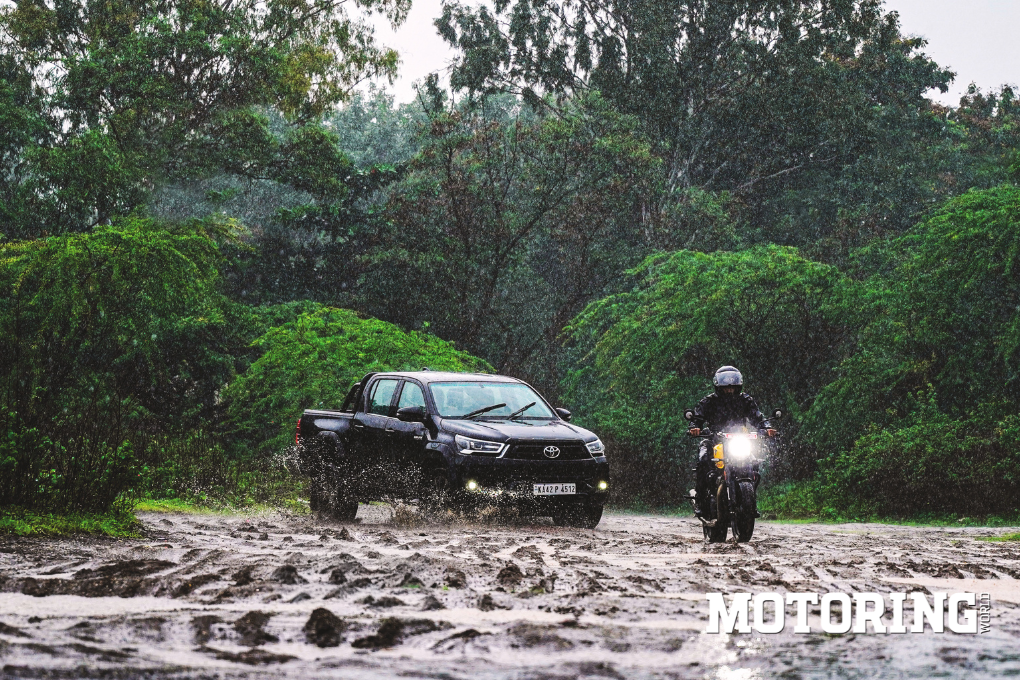
The city disappeared surprisingly quickly. Tower blocks gave way to paddy fields shimmering under heavy rain, while the roads narrowed until they became little more than ribbons of wet tarmac threading through impossibly green countryside. It wasn’t long before we found what we’d been hoping for: a network of muddy tracks criss-crossing open fields, punctuated by puddles that had grown into miniature ponds after days of relentless rain. If there is a natural habitat for a Hilux, this was surely it.

Ours had already lived a hard life. It had spent months in the hands of journalists, photographers and videographers, accumulated thousands of demanding kilometres and carried enough camera equipment to outfit a small production company. Yet it still felt every bit as solid as the day it arrived. There wasn’t a squeak or rattle to suggest it had endured anything out of the ordinary. It simply shrugged off another miserable afternoon and waited to see what we’d throw at it next. It didn’t have to wait long.
The first pass through the puddles was almost sensible. Almost. I eased the Hilux into the standing water to gauge what lay beneath, watching muddy spray fan gently out from either side before climbing back onto firmer ground. The second run was quicker. By the third, caution had disappeared entirely. Great sheets of brown water exploded into the air, the Hilux charging through with the sort of unflappable confidence that has made its reputation in some of the harshest places on earth. A gentle squeeze of the throttle was enough to coax the rear into
edging sideways, throwing another spectacular curtain of spray into the air while our cameras struggled to keep up. Every run became a little faster, every splash a little bigger.

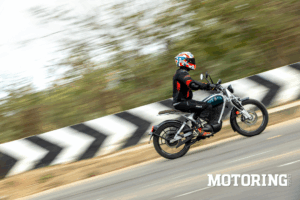
Watching from the sidelines, Hridhay was having just as much fun on the Triumph Tracker 400. Where the Hilux felt solid and unstoppable, the Tracker attacked the same terrain with an entirely different personality. It skipped across the muddy tracks, danced through puddles and soaked up deep ruts with an ease that made the conditions look almost inviting. Before long, the bright yellow paintwork had disappeared beneath a generous coating of mud, somehow making the bike look even better than it had that morning. Trackers have always been about escaping the confines of smooth tarmac, and the 400 X captures that spirit beautifully.

Eventually, curiosity got the better of me, and we swapped keys. The difference in perspective was immediate. From the commanding driving position of the Hilux, the world had felt comfortably distant, every puddle something to drive through without a second thought. On the Tracker, you became part of it. The spray landed on your boots, the handlebars wriggled gently over loose ground, and every change in the surface travelled straight through the bike. The Hilux gave you confidence to keep going; the Tracker made every metre feel like an event.

That afternoon made me realise that freedom has surprisingly little to do with where you go. We’d travelled barely any distance from the office, yet it felt as though we’d left the week behind entirely. Neither machine had taken us somewhere extraordinary. They had simply encouraged us to stop overthinking, follow a muddy track instead of another meeting invitation and spend a few hours enjoying the sort of weather most people were trying to avoid.

Eventually the cameras filled with memory cards, the puddles lost their novelty and we pointed both machines back towards the city. The traffic was exactly where we’d left it, and the deadlines hadn’t magically disappeared, but neither seemed quite as important as they had a few hours earlier. The Hilux and the Tracker 400 couldn’t stop the rain, clear the inbox or shorten the to-do list. What they could do was provide the excuse to step away from all of it for an afternoon. Sometimes that’s all the adventure you need, and sometimes it’s enough to remind you why we fell in love with cars and motorcycles in the first place.